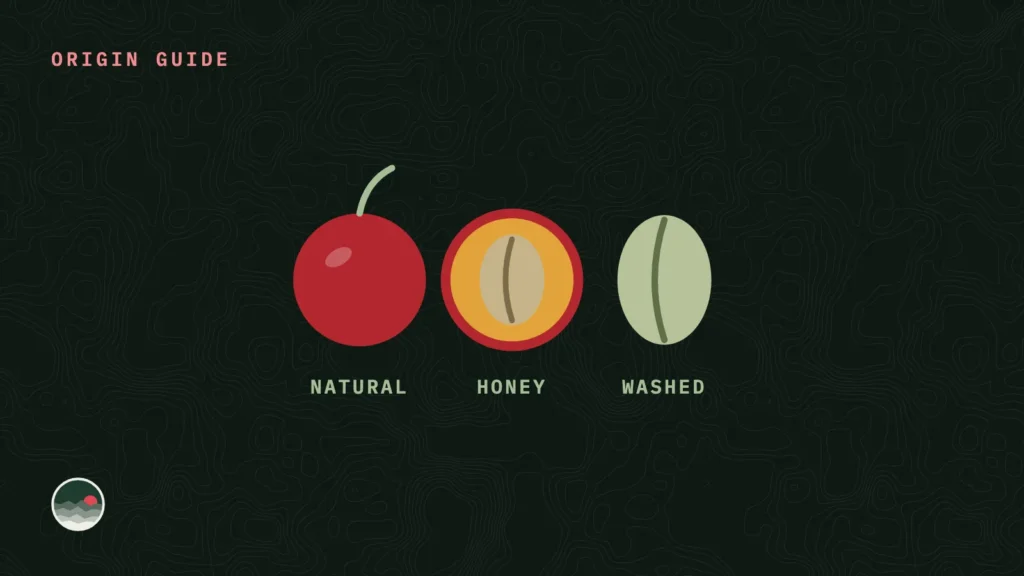
Quick answer
Processing is how the coffee seed is separated from the fruit around it and dried, and it changes the cup about as much as origin does. Washed coffees are usually the cleanest and brightest, naturals are fruitier and heavier, and honey-processed coffees sit in between, with noticeable sweetness. If you’re not sure, start with a washed coffee for clarity and try a natural when you want fruit.
The three main methods at a glance
| Method | What happens | The cup tends to be | Good if you like |
|---|---|---|---|
| Washed | The fruit is removed before drying, and the beans are fermented and rinsed | Clean, bright and clear | Clarity, acidity and delicate flavors |
| Honey | The skin and most of the pulp are removed, but some sticky mucilage stays on while the beans dry | Sweet, with more body than washed and a cleaner finish than natural | Sweetness and balance |
| Natural | The whole cherry is dried with the seed inside | Fruity, smooth and heavy-bodied, with more variation | Big fruit flavor and body |
What is coffee processing?
A coffee bean is the seed of a fruit called a cherry. Around the seed there’s a layer of fruit pulp and a sticky layer called mucilage. Before the seed can be roasted, those layers have to come off and the seed has to dry. The way a producer does that is called processing, and how much fruit stays on the seed while it dries is what changes the flavor.
Washed (wet) process
In the washed process, the mucilage is removed before the beans dry. Producers typically ferment the beans for roughly 12 to 48 hours, rinse them, and then dry them on patios or raised beds. Because the fruit is gone before drying, washed coffees tend to be the cleanest and brightest, and the flavor of the origin comes through clearly. It needs a lot of water and skill, which is one reason it can cost more.
Natural (dry) process
In the natural process, the whole cherry dries with the seed inside, so the fruit’s sugars pass into the bean. Natural coffees are best known for being fruity, smooth and heavy-bodied. The trade-off is variability: the fruit has to dry evenly around the seed, and it can ferment unevenly if drying goes wrong.
Honey (pulped natural) process
There’s no honey in honey-processed coffee. The name comes from the sticky mucilage. In this method the skin and most of the pulp are removed, but the mucilage stays on the bean as it dries. Producers control how much to leave. Honey coffees are generally sweet, and they sit between washed and natural: sweeter and heavier than a washed coffee, but cleaner and more controlled than a natural.
White, yellow, red and black honey
Honey coffees are often labeled by color, which describes how much mucilage was left on. White honey keeps the least and tends toward washed-style clarity. Black honey keeps the most and tends toward natural-style fruit and body. The more mucilage that stays on, the longer drying usually takes, and the higher the fermentation risk. The exact percentages for each color vary by producer.
What about Indonesian coffee?
Sumatran coffee is known for a heavy, syrupy body, low acidity and earthy, herbal notes, a style that is closely tied to how it’s processed in Indonesia. If you see “wet-hulled” on a bag, that’s the local method, and it’s why these coffees taste so different from washed coffees grown elsewhere.
How to choose
- You like tea-like, floral and citrusy: choose washed.
- You like sweet and balanced: choose honey.
- You like jammy, berry and bold: choose natural.
Processing also changes how an origin tastes. A washed Ethiopian tends toward citrus and a tea-like body, while a natural Ethiopian tends toward berries and a deeper body. Our coffee growing regions flavor map shows how origin and flavor fit together.
Reading the label
The process is usually printed next to the origin and the roast on a bag, or listed on the product page. If a coffee doesn’t say how it was processed, that’s worth asking about. Check each Regions coffee page for its process, roast and tasting notes.
Where this guide comes from
This is a researched guide that draws on roaster and coffee reference pages. Their descriptions agree on the basics, but numbers like fermentation times and honey percentages vary by source and producer, so treat them as ranges rather than rules.
Coffee processing FAQ
Which coffee processing method is best?
None is best. Washed is cleanest and brightest, natural is fruity and heavy, and honey is sweet and in between. The best one is the one that matches what you like in a cup.
Is there honey in honey-processed coffee?
No. The name refers to the sticky mucilage that stays on the bean while it dries, which looks and feels a little like honey.
Why do natural coffees taste fruity?
The whole cherry dries around the seed, so the fruit’s sugars and flavors pass into the bean. That’s why natural coffees are known for fruit and a heavier body.
Is washed coffee less flavorful?
No. Washed coffees tend to be cleaner and brighter, so the flavor of the origin comes through clearly, but they aren’t lacking in flavor.
Is coffee fermented?
Fermentation happens to some degree in all of these methods. In washed coffee, producers ferment the beans in tanks, usually for roughly 12 to 48 hours, before rinsing them. In natural coffee it happens inside the drying cherry, which is why naturals are more variable.
Does the process change how I should brew?
A little. Start with the usual recipe for your method, then adjust to taste. Our coffee ratio and grind size chart has ratios and grind sizes, and our guide to brewing coffee at home has more detail.
Try it with Regions coffee
Check the product page of any Regions coffee for the process, the roast and the tasting notes. Try Fruits of Kochere, an Ethiopian coffee from Kochere in Yirgacheffe, or Hills Over Huila, from Huila in Colombia. Several of our coffees are still listed as coming soon, so check each page for availability.