As an Amazon Associate, Regions Coffee Supply earns from qualifying purchases, at no extra cost to you.
Quick answer
For a washed, light-roast Ethiopian, start with 20 g of coffee and 320 g of water at 200 to 205°F in a V60, with a medium-fine grind and a total brew time of about 2:45 to 3:00. Bloom with about twice the coffee’s weight in water, then pour in two steady stages. If it tastes sour, go finer or hotter, and if it tastes bitter, go coarser or a little cooler.
The starting recipe
| Step | Water on the scale | Time | What to do |
|---|---|---|---|
| 1. Rinse and preheat | None | Before you start | Rinse the paper filter with hot water, and discard the water. |
| 2. Bloom | 40 g | 0:00 to 0:45 | Pour about twice the coffee’s weight in water, evenly over the grounds, and let it bloom. |
| 3. First pour | 200 g | 0:45 | Pour in slow circles, keeping the stream gentle. |
| 4. Second pour | 320 g | 1:30 | Pour in steady circles up to your final weight. |
| 5. Draw down | 320 g | Finish by 2:45 to 3:00 | Give the dripper one gentle swirl so the bed settles flat. |
What to know about Ethiopian coffee
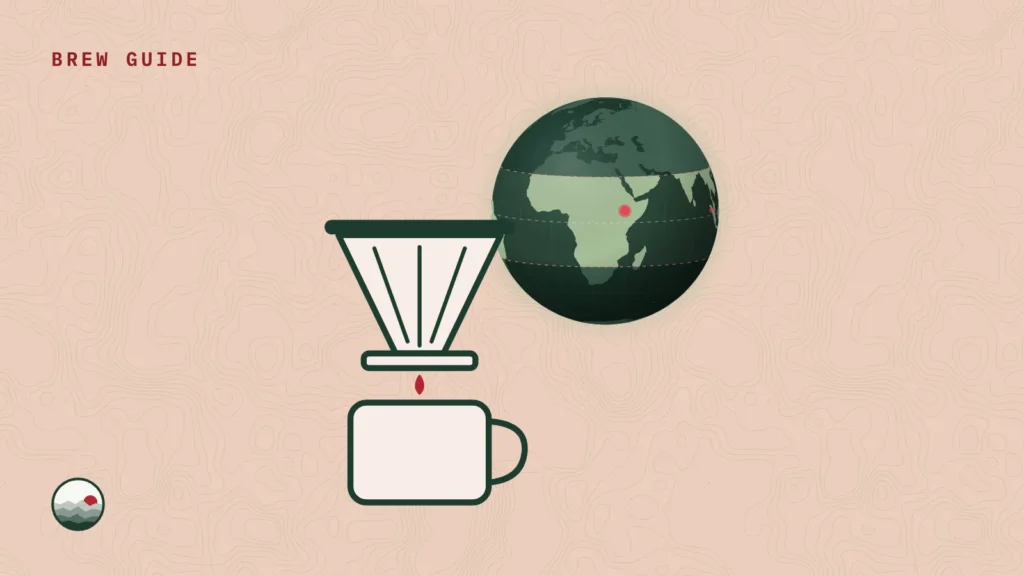
Ethiopian coffee is known for floral and fruity flavors, including berries, lemon, jasmine and bergamot. Washed Ethiopians tend toward citrus and a tea-like body, and natural ones tend toward berries and a deeper body. Yirgacheffe, a district in the Gedeo zone, is often described as floral and tea-like, and Sidama as berry-forward. Kochere is another Gedeo district, and Guji, in Oromia, can range from floral and tea-like to melon and peach.
Because the flavors are delicate, these coffees are usually roasted light and brewed with a clean method like a V60. For more on how processing changes the cup, see our guide to coffee processing, and our coffee growing regions flavor map for the bigger picture.
The gear you’ll need
- A V60 and filters: the Hario V60 02 and V60 02 filters.
- A scale that reads to 0.1 g: see our guide to the best coffee scales. The Hario V60 Drip Scale is a good match for a V60.
- A gooseneck kettle: see our guide to the best gooseneck kettles. The Bonavita 1L kettle is our value pick.
- A burr grinder: see our guide to the best coffee grinders. The Baratza Encore is a good starting point.
How to adjust the recipe
- Sour, thin or sharp: grind a little finer or raise the water temperature a few degrees.
- Bitter, harsh or dry: grind a little coarser or lower the temperature slightly.
- Heavy or muddy, which can happen with a natural: try a slightly coarser grind, or a bit more water, for example 1:17.
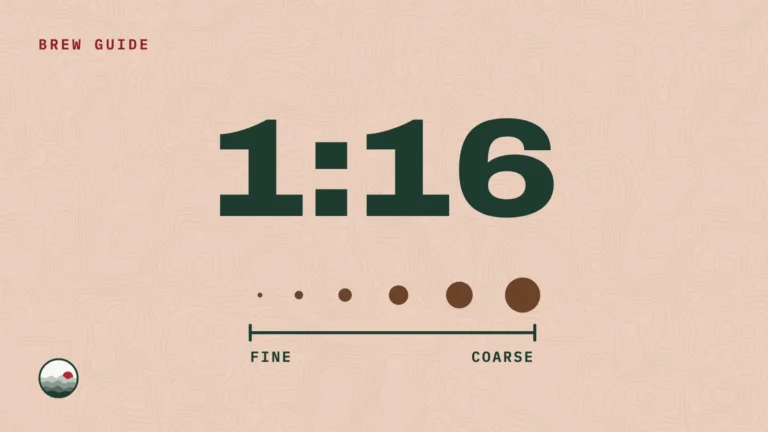
- Too weak: use a little more coffee, so go toward 1:15.
Change one thing at a time, and write down what you did. Our coffee ratio and grind size chart has starting ratios and grind sizes for other brewers, and our guide to brewing coffee at home covers the basics.
Other brewers
The same ideas work in other drippers. In a Chemex, use a slightly coarser grind and a bigger batch, for example 50 g of coffee to 800 g of water. A Kalita Wave is a little more forgiving, so it’s a good place to start if the V60 feels fiddly. Our V60 vs Chemex vs Kalita Wave guide compares them.
Where this recipe comes from
This recipe is a starting point adapted from published V60 recipes for light-roast Ethiopian coffees and from the ratios in our chart. It isn’t a lab-tested recipe, and we haven’t tested it on every Ethiopian coffee. Temperature, grind and time are the things to adjust for your coffee.
We haven’t tested every product in this guide. We’ve been brewing coffee at home for more than 15 years, and our own setup is a Technivorm Moccamaster (Stone Grey), an original AeroPress, a 10-cup Chemex and a Hario V60. We only describe something as our own experience when it’s one of those. Everything else is a researched pick, based on manufacturer details, Amazon listings and customer ratings we checked in October 2026.
Brewing Ethiopian coffee FAQ
What grind size is best for Ethiopian coffee?
Start with medium-fine, a little coarser than table salt. If it tastes bitter, go a little coarser. If it tastes sour or thin, go a little finer.
What water temperature should I use?
About 200 to 205°F (93 to 96°C) is a good starting point for a light roast, with the hotter end for lighter roasts and darker ones a little cooler.
Why does my Ethiopian coffee taste sour?
Sourness usually means under-extraction. Try a finer grind, hotter water or a slightly longer brew.
Are washed and natural Ethiopian coffees brewed differently?
The method is the same, but they can taste different. Washed coffees tend to be cleaner and more citrusy, and naturals are fruitier and heavier. If a natural tastes heavy or muddy, try a slightly coarser grind.
Can I brew Ethiopian coffee in a Chemex or an AeroPress?
Yes. A Chemex gives a very clean cup and suits bigger batches, and an AeroPress is more forgiving. Use our coffee ratio and grind size chart for a starting ratio and grind.
Do I need a scale and a gooseneck kettle?
They help a lot. A scale lets you repeat a recipe, and a gooseneck kettle gives you control of your pour. See our guides to the best coffee scales and the best gooseneck kettles.
Try it with Regions coffee
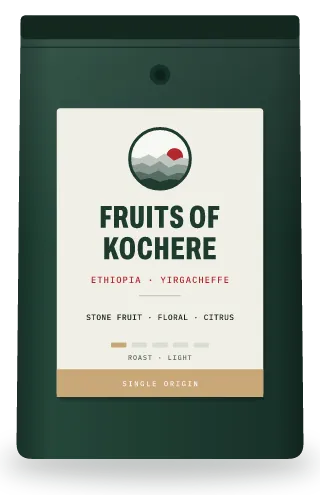
Fruits of Kochere is an Ethiopian coffee from Kochere in Yirgacheffe, so it’s the one to try with this recipe. Check the product page for its roast, process and tasting notes, and use slightly cooler water if it’s a darker roast. Several of our coffees are still listed as coming soon, so check availability too.