As an Amazon Associate, Regions Coffee Supply earns from qualifying purchases, at no extra cost to you.
Quick answer
The Breville Bambino is the best beginner espresso machine for most people: it’s compact, Breville says it heats up in about three seconds, and it makes real espresso with a standard 54 mm portafilter. The De’Longhi Dedica is the cheaper way in, the Gaggia Classic Pro rewards tinkering, and the Breville Barista Express is the all-in-one if you don’t want to buy a separate grinder. Whichever you choose, budget for a good grinder, because it matters as much as the machine.
Our picks at a glance
Best for most beginners
Breville Bambino
54 mm portafilter, ThermoJet heat-up in about 3 seconds, steam wand
Budget and small kitchens
De’Longhi Dedica Deluxe EC685
15-bar pump, slim body, adjustable frother
Automatic milk texturing
Breville Bambino Plus
The Bambino plus an automatic steam wand
Tinkerers who want to upgrade later
Gaggia Classic Pro
58 mm commercial-style portafilter, three-way solenoid valve
All-in-one with a built-in grinder
Breville Barista Express
Integrated conical burr grinder, 54 mm portafilter, PID temperature control
Price range is relative to other home espresso machines. Use the Check price links for today’s price and stock.
Before you buy an espresso machine
Espresso is the fussiest way to brew at home. It needs a machine that makes about 9 bar of pressure, a grinder that can grind very fine and adjust in small steps, a scale, and some patience while you dial in your grind. If you’re not sure you’ll stick with it, an AeroPress makes espresso-style coffee for much less, and we use an original AeroPress ourselves.
If you do want a machine, buy a grinder first or at the same time. A grinder built for filter coffee often can’t grind fine enough or adjust in fine enough steps for espresso, and a weak grinder holds back a good machine.
The best beginner espresso machines
01Breville Bambino: best for most beginners
The Bambino is a small, simple semi-automatic machine. Breville’s ThermoJet heating system reaches extraction temperature in about three seconds according to the listing, so you aren’t waiting around, and it has low-pressure pre-infusion, PID temperature control and a 54 mm portafilter with a steam wand for milk. It takes up very little counter space.
Amazon ratings are lukewarm (4.0 stars from more than 2,600 ratings at the time of writing), which is common for entry-level machines. You’ll need a separate grinder.
02De’Longhi Dedica Deluxe EC685: the budget way in
A slim 15-bar pump machine with a 35 oz removable tank, a thermoblock heater, an adjustable frother and a raised drip tray for taller glasses. It’s the cheapest machine here and it fits in a small kitchen. Ratings are 4.0 stars from more than 2,300 ratings at the time of writing. Amazon sells several versions of the Dedica, including 220-volt models for Europe, so make sure you buy the US EC685M.
03Breville Bambino Plus: automatic milk texturing
The Bambino Plus adds an automatic steam wand that lets you set the milk temperature and texture, which is helpful if you want lattes without learning to steam by hand. It uses the same 54 mm portafilter as the Bambino. Reviews are mixed (4.1 stars from more than 2,400 ratings at the time of writing), and some owners report reliability problems, so check the warranty before you buy.
04Gaggia Classic Pro: for tinkerers
The Classic Pro is a plain, sturdy machine made in Italy, with a steel housing, a commercial-style 58 mm portafilter, a commercial three-way solenoid valve and a commercial-style steam wand. It has simple switches instead of a screen, so it asks more of you, and it’s popular with people who like to upgrade and tinker. It has 4.3 stars from about 3,200 ratings on Amazon at the time of writing. Amazon lists this one under the model number RI9380/46. Gaggia has sold successive versions of this machine as the Classic Pro, Classic Evo Pro and Classic E24, so check which version you’re getting.
05Breville Barista Express: all-in-one with a built-in grinder
The Barista Express has an integrated conical burr grinder that grinds on demand straight into the portafilter, a 54 mm portafilter, PID temperature control and a manual steam wand for hand-textured milk. Because the grinder is built in, it’s the simplest way to get started if you don’t want to buy a separate grinder. It’s very widely reviewed, with 4.4 stars from nearly 28,000 ratings at the time of writing. It’s the most expensive machine here and takes up more counter space.
What you need besides the machine
- A grinder (unless it’s built in). The Baratza Encore ESP has a dual-range dial with micro-steps for espresso, and the Breville Smart Grinder Pro grinds by time and has 60 settings. On a smaller budget, a hand grinder like the Timemore Chestnut C3 ESP Pro is built with espresso in mind.
- A scale. Weigh your dose and your shot. See our guide to the best coffee scales.
- Fresh whole beans. Espresso shows up every flaw, so use good coffee.
A common starting recipe is 18 g of ground coffee in and 36 g of espresso out in about 25 to 30 seconds. If the shot runs too fast and tastes sour, grind finer. If it runs slowly and tastes bitter, grind coarser. Our coffee ratio and grind size chart has ratios for other methods.
How we chose these machines
We looked for machines that are approachable for a beginner: a standard portafilter, enough control to learn on, steam for milk drinks and good availability. We weighed customer ratings, reliability complaints, size, and how much extra gear each one needs. We left out any model that wasn’t in stock on Amazon when we checked in October 2026.
We haven’t tested any of these machines. We’ve been brewing coffee at home for more than 15 years, and our own setup is a Technivorm Moccamaster (Stone Grey), an original AeroPress, a 10-cup Chemex and a Hario V60. We only describe something as our own experience when it’s one of those. Everything else is a researched pick, based on manufacturer details, Amazon listings and customer ratings we checked in October 2026.
Beginner espresso machine FAQ
What’s the best espresso machine for a beginner?
The Breville Bambino is the one we’d point most beginners to, because it’s compact, heats up quickly and uses a standard portafilter. If you want an all-in-one, the Barista Express has a built-in grinder. If you want the cheapest way in, look at the De’Longhi Dedica.
Do I need a separate grinder for espresso?
Yes, unless the machine has one built in, as the Barista Express does. Espresso needs a very fine, consistent grind with small adjustment steps. See our guides to the best coffee grinders and the best hand coffee grinders.
What’s the difference between the Bambino and the Bambino Plus?
The Plus adds an automatic steam wand that lets you set the milk temperature and texture. The standard Bambino is simpler and cheaper, and you steam the milk yourself. Both use a 54 mm portafilter.
Can I use pre-ground coffee in an espresso machine?
Some machines include pressurized baskets that tolerate pre-ground coffee, but pre-ground coffee is rarely fine or fresh enough for good espresso. Grinding your own gives much better results.
What’s a good espresso recipe to start with?
Start with 18 g of coffee in and 36 g of espresso out in about 25 to 30 seconds, then adjust your grind. Our coffee ratio and grind size chart has ratios and grind guidance for other methods.
Is an AeroPress a good alternative?
It’s a good, low-cost alternative. The AeroPress makes espresso-style coffee with a rich, concentrated cup, but it isn’t true espresso and doesn’t steam milk. We use an original AeroPress.
Brew it with Regions coffee
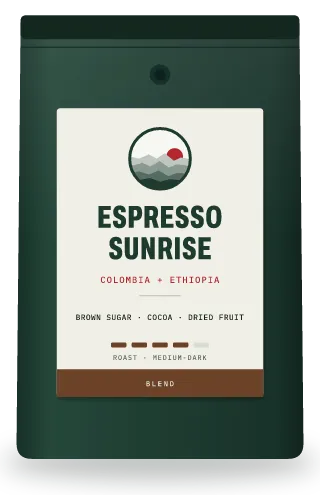
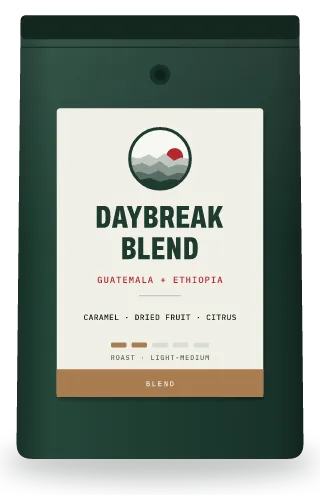
Try Espresso Sunrise, a blend named for espresso, or Daybreak Blend if you’d like to try another blend. Check each page for roast level and tasting notes, and note that several of our coffees are still listed as coming soon, so check availability too.
Setting up a home bar? See our guides to the best coffee scales and the best coffee grinders, and our guide to brewing coffee at home for filter methods.