
On this page
- Quick answer
- Tanzania’s coffee regions at a glance
- What is a peaberry?
- Do peaberries taste different?
- Why is Tanzania known for peaberry?
- What does Tanzanian coffee taste like?
- Tanzania’s coffee regions
- How Tanzanian coffee is grown and sold
- How to brew Tanzania peaberry
- Where this guide comes from
- Tanzania peaberry FAQ
- Try a similar Regions coffee
Quick answer
Tanzania peaberry is coffee made only from peaberries: single, round beans from coffee cherries that grew one seed instead of the usual two. Peaberries make up roughly 5 to 10 percent of a crop in every coffee country, but in the US the name has been tied to Tanzania since at least the 1970s. Tanzanian coffee itself is bright and sweetly tart, like a gentler Kenyan coffee, with citrus, black cherry and honey. Peaberries often taste a little brighter and lighter than flat beans from the same farm, but it varies from lot to lot, so judge the coffee, not the bean shape.
Tanzania’s coffee regions at a glance
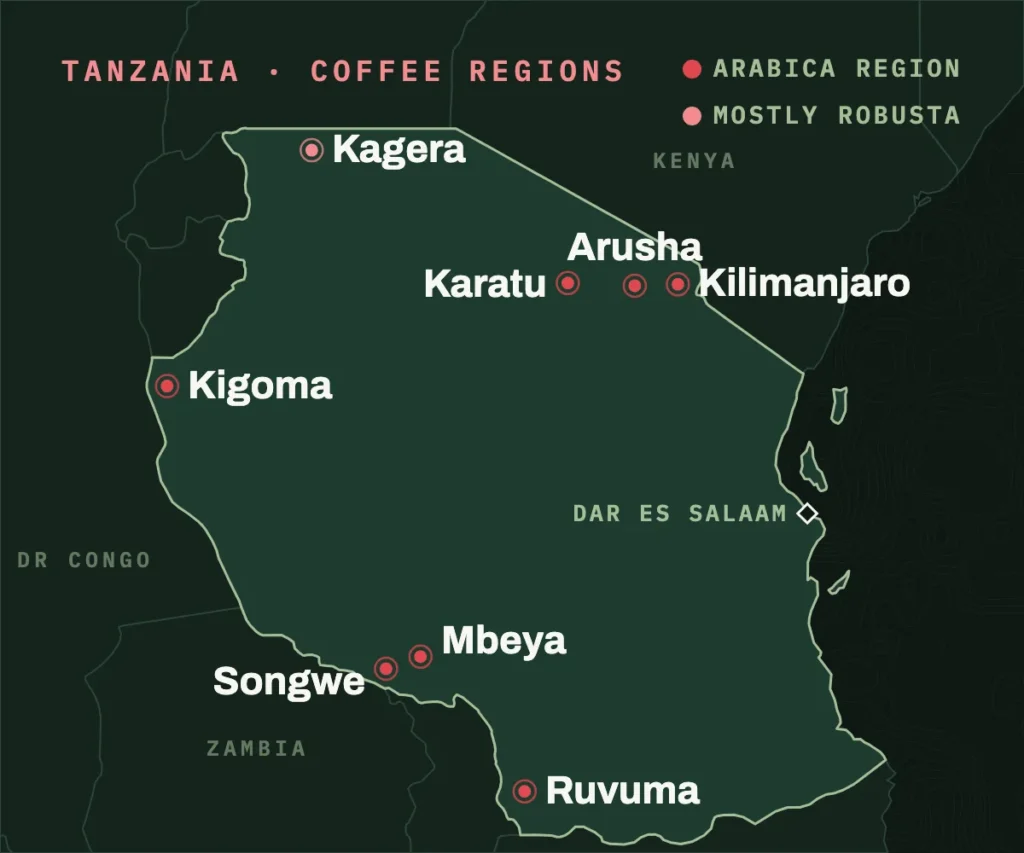
| Region | Where | Worth knowing |
|---|---|---|
| Kilimanjaro | Around Moshi | Famous name, small crop today |
| Arusha | Mount Meru | Bright and intense |
| Karatu | Near Ngorongoro | Northern estates and smallholders |
| Mbeya and Songwe | Southern highlands, with Mbozi | Much of today’s Arabica |
| Ruvuma | Mbinga, in the far south | About a quarter of the Arabica |
| Kigoma | Lake Tanganyika | Fine coffee, far from the ports |
| Kagera | Lake Victoria | Mostly Robusta |
What is a peaberry?
Most coffee cherries hold two seeds that grow face to face, which is why an ordinary coffee bean has one flat side. Sometimes only one seed develops, and it grows into a small, rounded, oval bean: a peaberry. Estimates of how common they are run from about 5 percent of a crop to 10 or 12 percent, and some farms see more.
Peaberries turn up in every coffee-growing country. They aren’t a variety or a species like Arabica or Robusta, just a shape, which our guide to types of coffee beans puts in context. Mills that want to sell them on their own sort them out of the crop, and in Tanzania they’re sold under the grade PB.
Do peaberries taste different?
Sometimes, a little. Kenneth Davids of Coffee Review, who has cupped many Tanzanian peaberries, finds them more often than not slightly lighter in body and a touch brighter than flat beans from the same lot. He’s also had heavier ones, and he doesn’t buy the idea that peaberries are simply better, or worse.
You’ll often read that their round shape rolls in the roaster and roasts more evenly. A 2023 study from Cenicafé, Colombia’s coffee research center, did find peaberries roasted evenly and scored the same as flat beans in the cup, but it tested a single variety, so it isn’t settled. The fair takeaway: a peaberry lot is worth trying for its own sake, not a guarantee of a better cup.
Why is Tanzania known for peaberry?
Nobody’s quite sure. By the 1970s, Tanzanian peaberry was already a familiar name in American specialty coffee, and it stuck. One explanation from importers: Japanese roasters, big buyers of Tanzanian coffee, have traditionally preferred flat beans, which leaves more peaberry lots for buyers in the US and Europe. There’s no data showing Tanzania grows more peaberries than anywhere else.
Tanzania’s other grades go by bean size, from AA, the largest, down through A and B, with PB for peaberries. Like Kenya’s grades, they describe size and shape, not flavor.
What does Tanzanian coffee taste like?
Think of a gentler Kenyan coffee. Tanzania’s best washed Arabicas are bright and sweetly tart, with orange and lemon, black cherry, plum and honey, and sometimes a cacao nib or black tea finish. They’re usually less intense and more balanced than Kenya’s, which our Kenyan coffee guide describes.
Region shows in the cup. Coffees from the north, around Kilimanjaro and Arusha, tend to be brighter and more intense. Coffees from the southern highlands around Mbeya and Mbinga are often softer and more floral.
Tanzania’s coffee regions
The north: Kilimanjaro, Arusha and Karatu
Tanzanian coffee made its name on the volcanic slopes around Moshi and Arusha, and near the Ngorongoro Crater around Karatu and Oldeani, where importers list lots at about 1,800 to 1,900 m. Kilimanjaro is still the name on many bags, but the north now grows a small share of the crop: in 2020/21, Kilimanjaro and Arusha together produced about 3,300 tonnes.
The southern highlands: Mbeya, Songwe and Ruvuma
Most of Tanzania’s Arabica grows here today, at about 1,600 to 1,900 m by importers’ notes. Ruvuma, around Mbinga, and Songwe, around Mbozi, each produced about 12,000 tonnes in 2020/21. Ruvuma alone grows about a quarter of the country’s Arabica, and Songwe was the second-biggest Arabica region in 2024. If your bag says Mbozi, Mbeya or Mbinga, it’s from the south.
The west: Kigoma and Kagera
Kigoma, by Lake Tanganyika, grows fine Arabica but is a long way from the ports. Kagera, on Lake Victoria in the northwest, is Tanzania’s Robusta country and its biggest coffee region by weight, about 41,000 tonnes in 2020/21. Most of its Robusta is dried as whole cherries.
How Tanzanian coffee is grown and sold
- Size: about 1.5 million 60 kg bags a year in recent USDA estimates, and roughly 60 percent Arabica by the Tanzania Coffee Board’s long-run average. Other estimates differ by year.
- Farmers: several hundred thousand smallholder families grow about 90 percent of the crop, alongside about 100 estates.
- Varieties: mostly Bourbon and Kent types, plus N39, selected at the Lyamungu research station, and newer hybrids from the Tanzania Coffee Research Institute bred to resist leaf rust and coffee berry disease.
- Processing: most Arabica is washed. Robusta is mostly dried as whole cherries.
- Harvest: about July to December in the north and south, and earlier, about May to October, in the west. Sources give slightly different months.
- Selling: much of the crop is sold at auction, at the long-running Moshi auction and newer regional and online ones run by the Tanzania Coffee Board. Exporters can also sell directly if the contract is registered with the board.
How to brew Tanzania peaberry
Pour-over brings out its fruit. On our Chemex we use about 34 g of coffee to 500 g of water, ground medium-coarse, like kosher salt. Rinse the filter, bloom with about twice the coffee’s weight in water for 30 to 45 seconds, then pour the rest in slow circles for a total of about 4 minutes. We grind a little coarser for the Chemex than for the V60, because its thicker filter slows the water.
On a V60, start at about 1:16, for example 22 g of coffee to 350 g of water, medium-fine, at 200 to 205°F. As with any new coffee, adjust from there: if it tastes sour, grind a little finer, and if it tastes bitter, a little coarser. Our pour-over ratio guide has both recipes step by step.
Where this guide comes from
The regional production figures are the Tanzania Coffee Board’s 2020/21 numbers, and the crop size comes from recent USDA estimates reported in the coffee trade press. The rest comes from the Tanzania Coffee Board and its research institute, importers’ and roasters’ origin notes, Coffee Review’s writing on Tanzanian peaberry and the 2023 Cenicafé study, all read in October 2026, not from a visit. Sources disagree on the peaberry share, harvest months and altitudes, so treat those numbers as typical ranges.
Tanzania peaberry FAQ
What is Tanzania peaberry coffee?
Coffee from Tanzania made only from peaberries, the single, round beans that grow when a cherry develops one seed instead of two. It’s sold under the grade PB.
Is peaberry coffee better?
Not necessarily. Peaberries often taste a little brighter and lighter, but the farm, the processing and the roast matter far more than the bean’s shape.
How much of a coffee crop is peaberry?
Roughly 5 to 10 percent, though estimates run a little wider and it varies from farm to farm.
What does Tanzanian coffee taste like?
Bright and sweetly tart, with citrus, black cherry, plum and honey. It’s often compared to Kenyan coffee, but softer and more balanced.
Is Tanzania peaberry the same as Kilimanjaro coffee?
Not always. Kilimanjaro is a region and peaberry is a bean shape. A Tanzania peaberry can come from Kilimanjaro, but today most Tanzanian Arabica grows in the southern highlands around Mbeya, Mbozi and Mbinga.
Do peaberries roast more evenly?
That’s a common claim, because they’re round and roll in the roaster. One 2023 study found they roasted evenly, but it tested a single variety, so it isn’t proven for every coffee.
Does Tanzania grow Robusta?
Yes, mostly in Kagera on Lake Victoria. The Tanzania Coffee Board puts Arabica at about 60 percent of the crop on average, and Robusta makes up the rest.
Try a similar Regions coffee
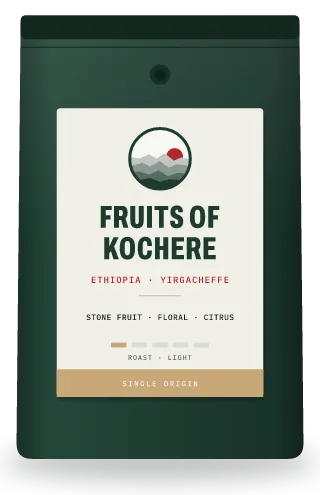
We don’t sell a Tanzanian coffee yet. If you like Tanzania’s bright, citrusy side, the closest in our lineup is Fruits of Kochere, from farther up the East African highlands in Ethiopia: a light roast from the Kochere area of Yirgacheffe with a floral aroma, juicy stone fruit and a citrus finish. Its page suggests 25 g of coffee to 400 g of water for pour-over or Chemex. It’s coming soon, and Notify me on its page will email you when it’s ready.