
Quick answer
Shade-grown coffee is coffee grown under a canopy of taller trees, the way coffee grew traditionally, instead of in open, full-sun rows. The trees give migrating songbirds a home, protect the soil and shelter the coffee, which can ripen more slowly. But “shade-grown” on a bag isn’t checked by anyone. The surest sign of real shade is the Smithsonian’s Bird Friendly seal: the coffee must be organic and grown under at least 40% shade from a tall, mixed canopy. Rainforest Alliance and organic seals don’t require shade.
What is shade-grown coffee?
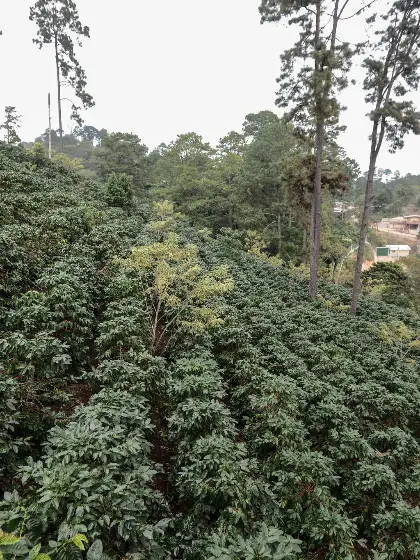
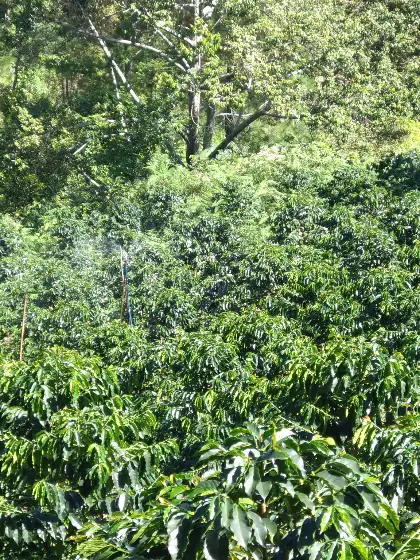
Coffee is an understory plant. It evolved in the forests of southwestern Ethiopia, and for most of its history it was grown under taller trees, often fruit trees or trees that add nitrogen to the soil. Shade farms look more like forest than farmland, with several layers of plants above the coffee bushes.
Starting in the 1970s, many farms in Latin America were converted to “technified” full-sun coffee, encouraged by governments and aid agencies. Cutting the trees and planting sun-tolerant varieties close together raised yields and was meant to help fight coffee leaf rust, but full-sun farms need more fertilizer, herbicides and pesticides. Plenty of smallholder farms never made the switch. Today, shade-grown coffee comes from places like Mexico, Central America, Colombia and Peru, and much of Ethiopia’s coffee still grows in forest or semi-forest under natural canopy, as our Ethiopian coffee guide explains.
| Shade-grown | Full sun | |
|---|---|---|
| Canopy | Several layers of trees | Few or no trees |
| Birds and wildlife | Many more species | Far fewer |
| Yield | Usually lower | Usually higher |
| Chemical inputs | Usually fewer | Usually more |
| Ripening | Slower | Faster |
Why shade-grown coffee matters for birds
Many North American songbirds, such as warblers, spend the winter in Central and South America, and shade coffee farms are some of the best habitat left for them outside natural forest. According to the Smithsonian Migratory Bird Center, studies in Colombia and Mexico found 94 to 97% fewer bird species on full-sun farms than on shade farms, and more than two-thirds of the birds on shade farms live in the canopy, not in the coffee bushes. A Smithsonian review of more than 50 studies also found that shade farms held more birds and did better on erosion control, carbon storage, pest control and pollination, while sun farms tended to produce more coffee.
Shade-grown, Bird Friendly, organic and Rainforest Alliance
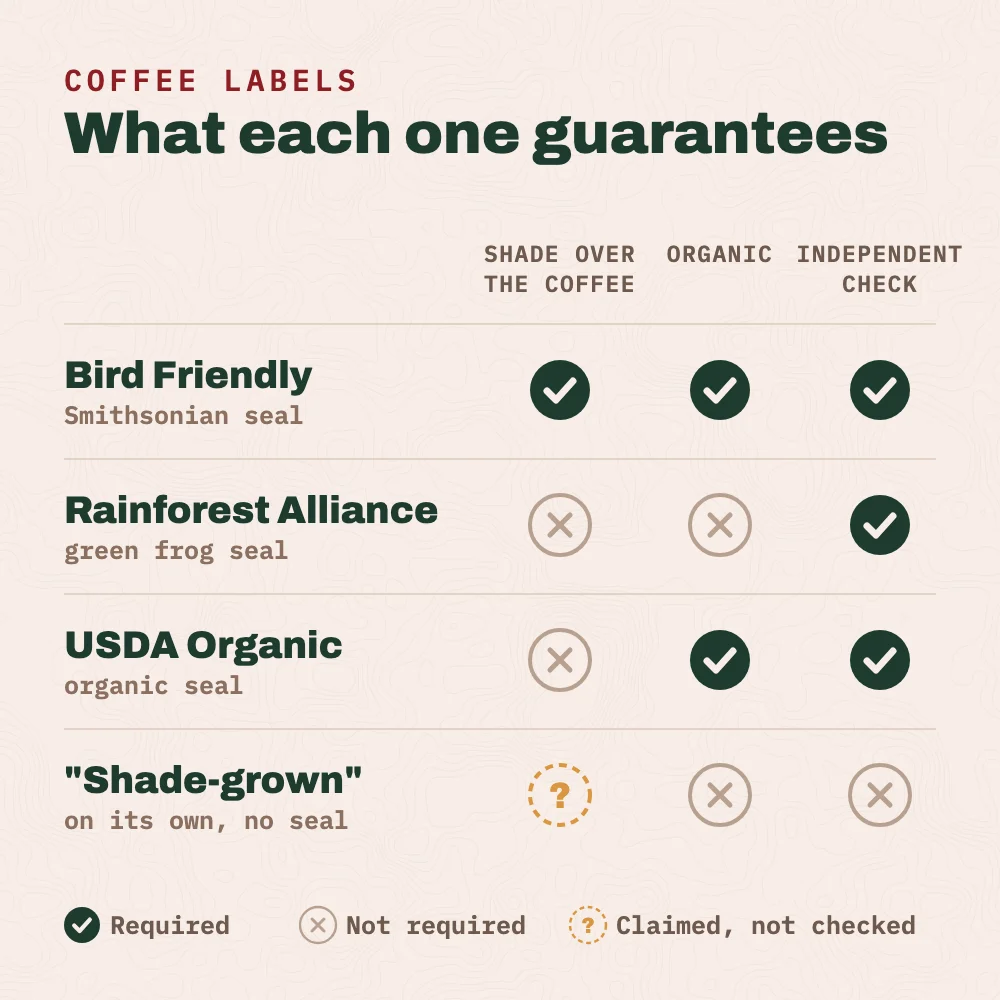
- Smithsonian Bird Friendly: the strictest. Farms must be certified organic and keep at least 40% shade from a tall canopy of about 10 or more tree species, in several layers. Inspectors check the shade during the farm’s organic inspection.
- Rainforest Alliance: the green frog seal covers a wide range of environmental and social standards, but since its 2020 standard it doesn’t require shade trees over the coffee itself. Rainforest Alliance coffee may or may not be shade-grown.
- USDA Organic: no synthetic pesticides or fertilizers, which suits shade farming well, but organic coffee can still be grown in full sun.
- “Shade-grown” on its own: a description, not a certification. It might mean a rich forest canopy or a few scattered trees, so ask the roaster how they know.
Fair trade and direct trade are about how farmers are paid, not how the coffee is grown, so they don’t tell you anything about shade.
Does shade-grown coffee taste better?
Sometimes. Shade cools the coffee plants and slows ripening, which gives the cherries more time to fill out. In a study in Costa Rica’s Central Valley, coffee grown under about 45% shade ripened up to a month later and made larger beans and a better cup, with less bitterness and astringency, than coffee grown in full sun. The benefit shows most on lower, warmer farms. High in the mountains, where it’s already cool, shade does less and can even hurt quality. Altitude, variety, ripe picking and processing still matter more than shade alone.
There’s no good evidence that shade-grown coffee is lower in acid. Acidity depends much more on altitude, origin and roast, as our guide to low acid coffee explains.
How to find shade-grown coffee
- Look for the Bird Friendly seal if you want a guarantee. The Smithsonian keeps a list of roasters that sell certified coffee.
- Ask about uncertified claims. A good roaster can tell you which farm the coffee came from and what the shade looks like there.
- Expect to pay a little more. Shade farms usually produce less coffee per acre, and certification costs money.
Where this guide comes from
This guide draws on the Smithsonian Migratory Bird Center’s research and Bird Friendly criteria, the Rainforest Alliance’s 2020 farm standard and independent reviews of it, a Costa Rican study of shade and coffee quality published in the Journal of the Science of Food and Agriculture, and research on the shift to full-sun coffee in Latin America. Certification rules change, so check the certifier’s current standard if you need the exact details.
Shade-grown coffee FAQ
What does shade-grown coffee mean?
Coffee grown under a canopy of taller trees rather than in full sun. Unless it carries a seal like Bird Friendly, nobody checks how much shade there really is.
What is bird friendly coffee?
Coffee certified by the Smithsonian Migratory Bird Center. It must be organic and grown under at least 40% shade from a tall, layered canopy of many tree species, which gives birds good habitat.
Is shade-grown coffee better?
For birds and wildlife, yes. For flavor, it can be, especially on lower, warmer farms where shade slows ripening, but altitude, picking and processing matter more.
Is Rainforest Alliance coffee shade-grown?
Not necessarily. Its 2020 standard doesn’t require shade trees over the coffee, so some Rainforest Alliance coffee is shade-grown and some isn’t.
Is organic coffee shade-grown?
Not always. Organic rules ban synthetic pesticides and fertilizers but don’t require shade. Bird Friendly coffee is both organic and shade-grown.
Where is shade-grown coffee grown?
Across the coffee belt, especially in Mexico, Central America, Colombia, Peru and Ethiopia, where much coffee still grows in forest or under planted shade trees.
Is shade-grown coffee less acidic?
There’s no good evidence that it is. Acidity depends much more on altitude, origin and roast.
Where Regions coffee fits
Our coffees aren’t certified Bird Friendly, organic or Rainforest Alliance, and we don’t claim they’re shade-grown. If that changes for any coffee, we’ll say so on its product page. Our How we source page explains where our coffees come from.