



On this page
- Quick answer
- Ethiopia’s coffee regions at a glance
- Why Ethiopian coffee tastes different
- Ethiopia’s coffee regions, one by one
- Washed vs natural Ethiopian coffee
- How to read an Ethiopian coffee bag
- A short history of coffee in Ethiopia
- How to brew Ethiopian coffee
- Where this guide comes from
- Ethiopian coffee FAQ
- Try it with Regions coffee
Quick answer
Ethiopian coffee is known for flavors you rarely find anywhere else: jasmine and other florals, lemon and bergamot, peach and berries. The names you’ll see most on bags are Yirgacheffe, which is floral, lemony and tea-like, Sidama (often spelled Sidamo), which leans toward berries and citrus, Guji, known for peach and stone fruit, and Harrar, a heavier, winey, blueberry-like coffee from the east. Washed Ethiopian coffees taste cleaner and brighter, and naturals taste fruitier and fuller. A light roast and a pour-over show them off best.
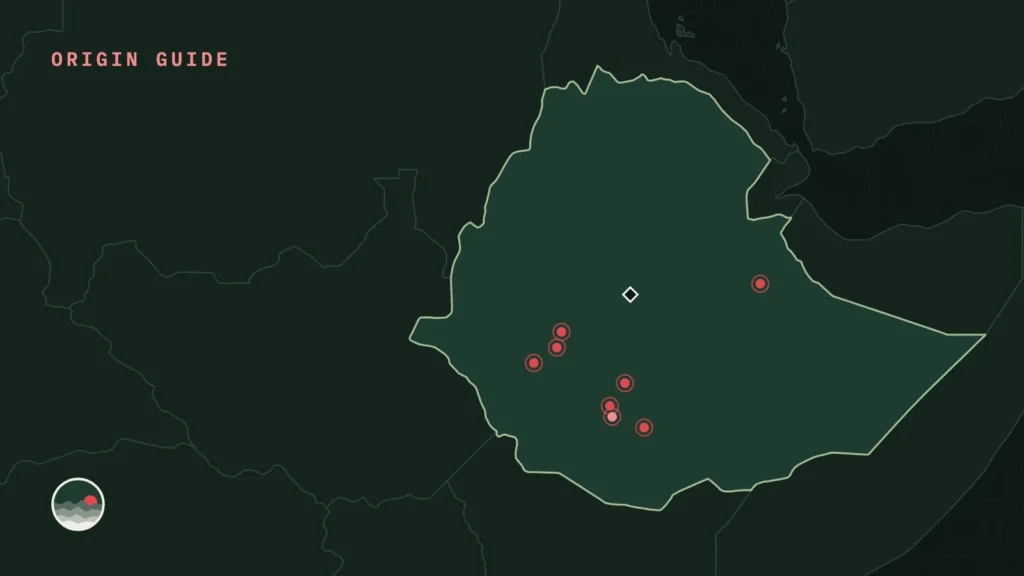
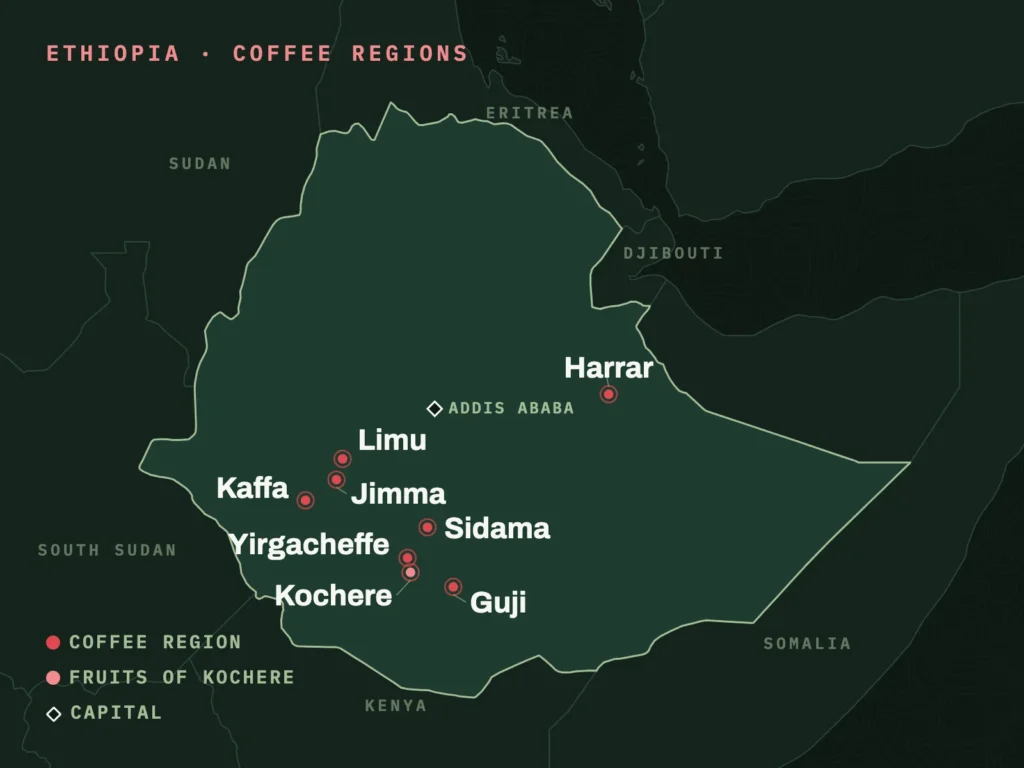
Ethiopia’s coffee regions at a glance
| Region | Usual process | What it tends to taste like |
|---|---|---|
| Yirgacheffe, including Kochere | Mostly washed, some natural | Jasmine, lemon and bergamot, with a light, tea-like body. Naturals lean toward blueberry and strawberry. |
| Sidama (Sidamo) | Washed and natural | Berry and citrus, with honeyed sweetness and a little more body |
| Guji | Natural and washed | Peach, stone fruit and florals. Naturals often taste of blueberry and tropical fruit. |
| Harrar | Almost always natural | Blueberry, jammy and winey, with spice and a heavier body |
| Limu | Mostly washed | Gentle acidity, floral and spicy, balanced |
| Jimma | Mostly natural | Earthier and heavier, with some fruit. Much of it is sold as everyday coffee. |
Why Ethiopian coffee tastes different
Varieties. Arabica coffee grows wild in the forests of southwestern Ethiopia, and the country has more genetic variety in its coffee than anywhere else. Most farms grow local types that have crossed with each other for generations, so bags usually just say “heirloom” or “landrace” instead of naming one variety. Our guide to the types of coffee beans explains arabica and its varieties. Some are newer selections from Ethiopia’s Jimma Agricultural Research Center, such as 74110 and 74112, which you’ll sometimes see on a label.
Altitude. Most of Ethiopia’s specialty coffee grows high, roughly 1,500 to 2,200 meters above sea level. Cooler temperatures slow down ripening, which gives the cherries time to build sugars and acids, and that’s a big part of the bright, layered flavor.
Processing. Ethiopia is known for both washed and natural coffees, and the difference shows in the cup. There’s more on that below, and in our guide to coffee processing.
Small farms. Most Ethiopian coffee comes from smallholders farming a hectare or less, often called garden coffee, who sell their cherries to a nearby washing station. Lots are built from many small farms, so a bag will usually name a washing station or cooperative instead of a single farm.
Ethiopia’s coffee regions, one by one
Yirgacheffe and Kochere
Yirgacheffe is a town and district in the Gedeo zone of southern Ethiopia, but on coffee bags the name covers much of the zone around it, including areas like Kochere, Gedeb and Konga. It’s the most famous name in Ethiopian coffee. The classic washed Yirgacheffe is light and floral, with jasmine, lemon and bergamot, the citrus in Earl Grey tea. Naturals from the same area taste more like blueberries and strawberries.
Kochere sits just south of Yirgacheffe town and is known for a sweet, fruit-tea character with citrus and stone fruit. Coffee there grows on small plots at around 1,800 to 2,100 meters. Our Fruits of Kochere comes from this area.
Sidama (Sidamo)
Sidama lies just north of Yirgacheffe and is one of Ethiopia’s biggest coffee regions. You’ll see two spellings. Sidamo is the older name of the province, and Sidama is the name of the people and, since 2020, of Ethiopia’s Sidama Region. Older bags and some importers still say Sidamo, and both mean the same place.
Sidama coffees are usually a little fuller than Yirgacheffe, with berry and citrus notes and a honeyed sweetness. Washed and natural lots are both common, and high areas like Bensa, in the east of the region, have become well known for specialty lots.
Guji
Guji is a zone in the Oromia region, east and south of Yirgacheffe. Its coffees were long sold as Sidamo, and they’ve carried their own name since the early 2000s. Districts like Hambela, Shakiso and Uraga now show up on bags in their own right.
Guji naturals are known for intense fruit, often blueberry, peach and tropical fruit. Washed Guji coffees tend to be floral and stone-fruity, and a little rounder than a Yirgacheffe.
Harrar
Harrar grows in the dry eastern highlands around the old walled city of Harar, far from the southern regions. Its coffees are almost always natural, dried inside the cherry, and are known for blueberry, jammy and wine-like flavors, with spice and a heavier body. A Harrar tastes very different from a washed Yirgacheffe, so it’s a good one to try side by side.
Limu, Jimma and Kaffa in the southwest
Southwest Ethiopia is greener and wetter. Limu is known for clean washed coffees with gentle acidity and floral, spicy notes. Nearby Jimma mostly produces naturals, and much of it goes into everyday coffee, though some washing stations around Agaro have become known for excellent lots. Further southwest, the forests of Kaffa and its neighbors are where Arabica still grows wild, and some coffee there is still picked from forest and semi-forest land.
Washed vs natural Ethiopian coffee
After the region, the process is the biggest clue on the bag.
- Washed: the fruit is removed before the beans dry. The cup is cleaner, lighter and brighter, with florals and citrus up front. This is the classic Yirgacheffe style.
- Natural: the whole cherry dries in the sun, usually on raised beds, before the fruit is removed. The cup is fruitier and heavier, often with blueberry or strawberry and a winey sweetness. Harrar is almost always natural, and Guji and Sidama naturals are popular too.
If you’re new to Ethiopian coffee, a washed Yirgacheffe is the easiest place to start. If you want something bold and fruity, try a natural. Our guide to washed, natural and honey processing explains each method.
How to read an Ethiopian coffee bag
- Region and area: a region like Yirgacheffe or Guji, and often a smaller area or a washing station. The more specific it is, the more you know about where the coffee came from.
- Process: washed or natural, which tells you more about the taste than anything else on the bag.
- Grade: G1 or G2, short for Grade 1 or Grade 2, is common on specialty coffee. Grades are about how clean and even the beans are, not how they taste, and Grade 1 has the fewest defects.
- Variety: usually “heirloom” or “landrace”, and sometimes a number like 74110.
- Altitude: higher usually means brighter and more delicate.
- Harvest and roast date: Ethiopia’s harvest runs roughly from October to January, and new-crop coffee usually reaches the U.S. in spring and early summer. Whatever the harvest, look for a recent roast date. Our guide to choosing coffee beans covers the rest of the label.
For years, most Ethiopian coffee was sold through the Ethiopia Commodity Exchange, set up in 2008, which pooled coffee by region and grade. That made it hard to tell which washing station a lot came from. Reforms starting in 2017 made direct sales and tracing much easier, which is why washing station names, and sometimes farmers’ names, now appear on Ethiopian coffees.
A short history of coffee in Ethiopia
Ethiopia is widely called the birthplace of coffee, because Arabica grows wild in its southwestern forests and is thought to have originated there. You may have heard the story of Kaldi, a goat herder who noticed his goats dancing after they ate coffee cherries. It’s a legend. The earliest written version dates from 1671, centuries after it’s supposed to have happened, and the first well-documented coffee drinking comes from Yemen, across the Red Sea, in the 1400s.
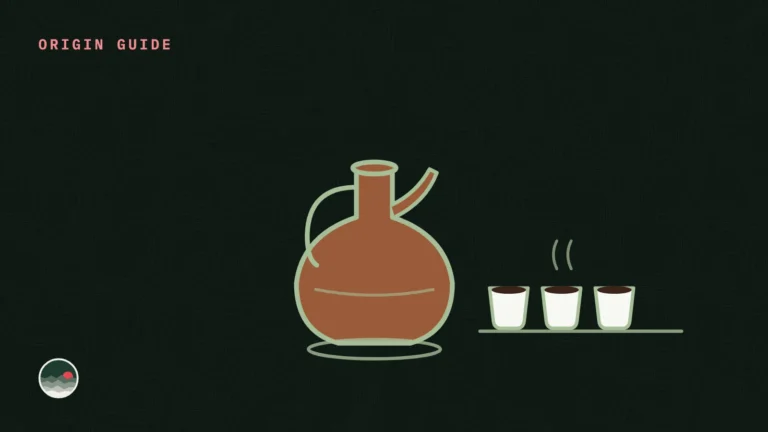
Coffee is still part of daily life in Ethiopia. The Amharic word for it is buna. A traditional coffee ceremony means roasting green beans in a pan, grinding them by hand and brewing them in a clay pot called a jebena, often served in three rounds. Ethiopians drink a big share of their own harvest, around a third of it in recent USDA estimates. Ethiopia is also Africa’s largest coffee producer, with a record harvest of about 11.6 million 60 kg bags forecast for the 2025/26 season.
How to brew Ethiopian coffee
Ethiopian coffees are usually roasted light to keep their florals and fruit, and a clean brewer like a V60 or Chemex shows them off best. A good starting point is 1:16, for example 20 g of coffee to 320 g of water, at 200 to 205°F with a medium-fine grind. If it tastes sour, grind finer. If it tastes bitter, grind coarser. Our guide to brewing Ethiopian coffee for pour-over has a full step-by-step recipe, and our coffee ratio and grind size chart covers other brewers.
Ethiopian coffees also make a great iced pour-over. Brew with less hot water than usual, straight onto ice, for example 30 g of coffee and 300 g of hot water over 180 g of ice, and the fruit and florals stay bright.
Where this guide comes from
This is a researched guide, not a report from a trip to Ethiopia. It draws on coffee importers’ origin guides, USDA reports on Ethiopia’s coffee harvest, and roaster and retailer guides, checked in October 2026. Sources often disagree on details like altitudes and flavor notes, so treat them as tendencies. Region names and borders in Ethiopia have also changed over the years, which is why the same coffee can be labeled in different ways.
Ethiopian coffee FAQ
What does Ethiopian coffee taste like?
Usually floral and fruity, and lighter-bodied than most coffees. Washed Ethiopians taste of jasmine, lemon and bergamot, with a tea-like body. Naturals taste of blueberry and strawberry, with a winey sweetness.
Is Ethiopian coffee good?
It’s among the most prized coffees in specialty coffee, especially if you like bright, fruity cups. If you prefer chocolatey, nutty coffee, Peru or Brazil may suit you better. Our coffee growing regions flavor map compares them.
What’s the difference between Yirgacheffe and Sidamo?
They’re neighbors. Yirgacheffe is usually lighter and more floral, with lemon and jasmine. Sidama, also spelled Sidamo, is a little fuller, with berry and citrus. Both can be excellent, washed or natural.
Is Ethiopian coffee usually a light roast?
Most specialty roasters roast it light to medium-light to keep the florals and fruit. You can find darker roasts, but those delicate flavors fade as the roast gets darker.
Is Ethiopia the birthplace of coffee?
Arabica grows wild there and is thought to have originated there, so Ethiopia is widely called coffee’s birthplace. The story of Kaldi and his goats is a legend, and the first documented coffee drinking was in Yemen in the 1400s.
What does Grade 1 mean on Ethiopian coffee?
It’s the grade with the fewest defects in the beans. Grade 2 allows a few more, and both are common on specialty coffee. The grade isn’t a flavor score.
Is Ethiopian coffee low in acid?
Usually not. Washed Ethiopians are some of the brightest coffees there are, while naturals and darker roasts taste softer. For a lower-acid cup, look at Sumatra or Brazil.
Try it with Regions coffee
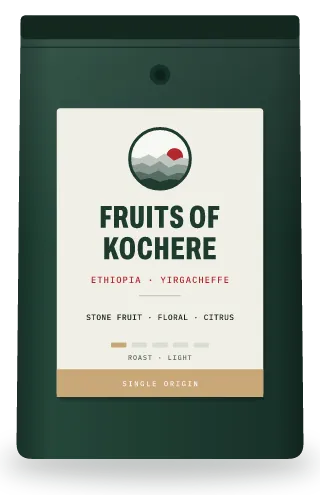
Fruits of Kochere is our Ethiopian coffee: a light roast from the Kochere area of Yirgacheffe, grown at 1,800 to 2,100 meters. It opens with a floral aroma, moves into juicy stone fruit and finishes with bright citrus, so it’s a good example of everything in this guide. It’s coming soon, so tap Notify me on its page to hear when it’s ready.
For the bigger picture, see our coffee growing regions flavor map, which compares Ethiopia with coffee from the rest of the world.