




As an Amazon Associate, Regions Coffee Supply earns from qualifying purchases, at no extra cost to you.
Quick answer
Start with four things: a tamper that fits your portafilter, a 12 oz stainless steel milk pitcher, a knock box and small cups you can warm. Match the tamper to your machine: 51 mm for a De’Longhi Dedica, about 53.3 mm for Breville’s 54 mm machines like the Bambino, and 58 to 58.5 mm for a Gaggia Classic Pro. Our picks are the Normcore V4 tamper, the De’Longhi 12 oz jug, the Dreamfarm Grindenstein knock box and Bodum Pavina glasses or notNeutral Lino cups. We don’t pull espresso at home, so these are researched picks, and a scale still matters more than any of them.
Our picks at a glance
A tamper that fits
Normcore V4 Tamper
Spring-loaded and self-leveling, in 51, 53.3 and 58.5 mm
Learning to steam
De’Longhi Milk Frothing Jug
A plain 12 oz stainless steel jug, the right size for one drink
Small counters
Dreamfarm Grindenstein
Rubber-covered steel knock bar, top-rack dishwasher safe
Café-style cups
notNeutral Lino
Porcelain cup and saucer, 3 oz espresso and 6 oz cappuccino
Price range compares each pick with others of its kind, tampers with tampers and cups with cups. Use the Check price links for today’s price and stock.
What size tamper do you need?
A tamper should fill the basket almost edge to edge. Too small, and it leaves a ring of loose coffee around the outside where water slips past. Too big, and it won’t go in. Tampers sold for a machine are often a fraction of a millimeter smaller than its portafilter, so they slide in without sticking. Breville is the case to know: most tampers made for its 54 mm portafilters measure about 53.3 mm.
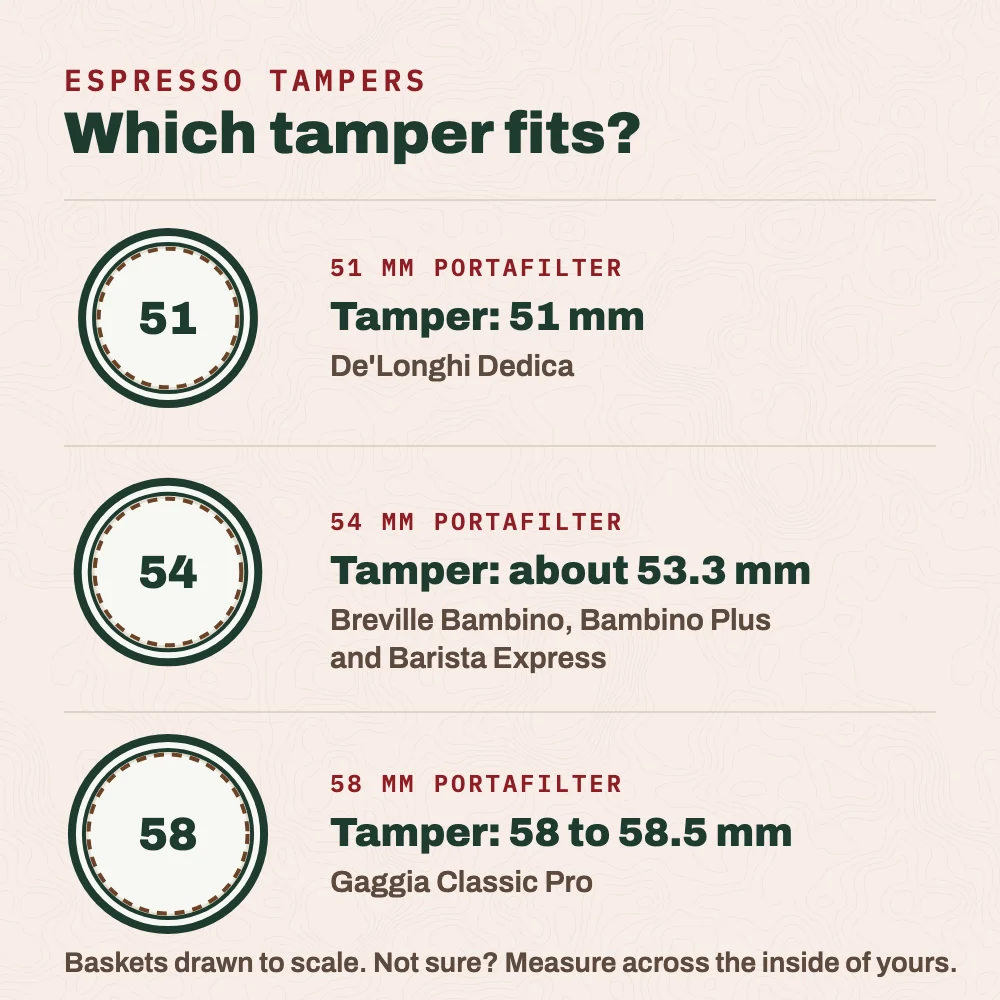
Machine not listed? Check the manual, or measure across the inside of your basket, and buy a tamper sold for that size. Aftermarket baskets vary a little, so if a tamper sticks or leaves a gap, check the listing’s fit notes. With dual wall (pressurized) baskets, fit and pressure matter less, because the basket builds the pressure for you. Once you switch to single wall baskets and fresh-ground coffee, a tamper that fits and a level, firm tamp start to show in the cup.
The espresso accessories we’d buy
01Normcore V4 Tamper: the tamper to buy first
Normcore’s V4 is a spring-loaded tamper. You press down until its outer ring meets the rim of the basket, and the spring sets the force, so every tamp comes out about the same and level. It comes with 15, 25 and 30 lb springs and a stand, and the base is flat stainless steel. Order the size for your machine: 53.3 mm for Breville’s 54 mm portafilters, 58.5 mm for 58 mm machines like the Gaggia Classic Pro, or 51 mm for the De’Longhi Dedica.
The tamper that came with your machine works if it fits. The reasons to upgrade are fit and consistency, and the spring takes one variable away while you’re still learning to dial in the grind. If you’d rather feel the tamp yourself, any solid tamper in the right size will do.
02De’Longhi Milk Frothing Jug: the pitcher to learn on
A plain 12 oz stainless steel jug from De’Longhi. Twelve ounces is the size our milk steaming guide recommends for one drink: fill it to the bottom of the spout, about a third full, and the milk has room to spin and grow. Steel also lets you feel the heat through the side, which is how you know when to stop.
If your machine came with a jug, as the Breville Bambino and Bambino Plus do, learn on that first. Buy this one when you want a second jug or a smaller one than your machine included.
03Fellow Eddy: the pitcher for latte art
Fellow’s Eddy also holds 12 oz, but it’s shaped for pouring: a fluted spout with a sharp crease that guides the milk forward, a tapered body that helps the milk spin, and lines inside at 6, 8 and 10 oz so you steam the same amount every time. It’s 18/8 stainless steel with an open ribbon handle, and it’s dishwasher safe. Fellow makes the kettle we use at home, though we haven’t used the Eddy.
It costs more than a plain jug, so it makes the most sense once you’re pouring hearts and tulips, not on your first week of steaming.
04Dreamfarm Grindenstein: a knock box for small counters
The Grindenstein is a compact plastic knock box, about 4 inches tall, with a rubber-covered steel bar to strike, so you can knock the portafilter hard without denting it or the box. It’s small enough to sit beside a compact machine like the Bambino, and it goes in the top rack of the dishwasher.
The tradeoff is size: it fills after a handful of pucks, so plan to empty it every day or two. If you pull several shots a day, Dreamfarm’s Big Grindenstein holds more, and Breville’s Knock Box 10 is brushed stainless steel to match a steel machine.
05Bodum Pavina: glass espresso cups that stay warm
Bodum’s Pavina espresso glasses hold 2.5 oz (80 ml), enough for a double shot, and come in a pair. They’re double-wall borosilicate glass, so the outside stays cool while the espresso keeps its heat, and you can watch the crema settle. They’re dishwasher safe. The thin glass makes them lighter and more fragile than porcelain, so they’re not the cups to knock around.
06notNeutral Lino: café-style cups and saucers
If you’d rather have a classic cup and saucer, notNeutral’s Lino is a porcelain line made for cafés as well as homes. The 3 oz espresso cup suits a single or double shot, and the 6 oz double cappuccino cup fits a cappuccino or flat white. Both come in pairs with saucers, are dishwasher and microwave safe, and come in white and a few colors. Thick porcelain holds heat once it’s warm, so rinse the cup with hot water before you pull the shot.
Which milk pitcher size?
- 12 oz (350 ml): one cappuccino, flat white or small latte at a time. Start here.
- 20 oz (600 ml): two drinks at once, or a large latte.
A pitcher that’s too big for the milk in it makes steaming harder, because shallow milk won’t spin into a whirlpool. Fill to the bottom of the spout and stop steaming at about 140 to 150°F, when the pitcher is almost too hot to hold. A plain round spout is easy to learn on. A sharper spout like the Eddy’s pours finer lines once you’re working on latte art. Our guide to steaming milk walks through it step by step.
What size espresso cups?
| Drink | Cup size |
|---|---|
| Espresso or macchiato | 2 to 3 oz |
| Cortado | 4 to 4.5 oz, often a glass |
| Cappuccino or flat white | 5 to 6 oz |
| Latte | 8 oz or more |
A small cup keeps a shot hot. Espresso is only about 1 to 2 oz, and in a big mug it cools fast and the crema spreads thin. Warm the cup first: fill it with hot water while the machine heats, then pour it out just before the shot. For milk drinks, our latte vs cappuccino guide explains how much milk goes in each.
Do you need a knock box?
Not on day one, but you’ll want one soon. A used puck is a damp, packed disk of coffee. Knocking it into the trash scatters grounds and can chip the bin or the portafilter, and rinsing pucks down the sink can clog it. A knock box gives you a padded bar to strike and somewhere to keep pucks until you empty them into the trash or compost.
What else helps, and what can wait
- A scale, before any of the above. We weigh our pour-overs on a Hario scale at home, and the same habit makes espresso repeatable: 18 g in and about 36 g out. For espresso, pick one that reads 0.1 g, has a timer and fits on your drip tray under the cup. Our coffee scale guide includes one with an espresso mode.
- A milk thermometer. A clip-on one helps you stop at 140 to 150°F until you can judge it by touch.
- A dosing funnel. It sits on top of the basket so grounds don’t spill over the edge when you grind or stir.
- A distribution tool. Thin needles that break up clumps before you tamp. Helpful once your shots are close but uneven.
- Puck screens, levelers and bottomless portafilters. Upgrades for later, once the basics are steady.
If you haven’t chosen a machine yet, our guide to the best beginner espresso machines covers the grinder too, and our Bambino vs Bambino Plus comparison helps if milk drinks are the main event.
How we chose these
We weigh coffee on a Hario scale and heat water in a Fellow kettle at home, but we don’t have an espresso machine, so every pick here is a researched one. We read the makers’ specs, Amazon listings and retailer pages in late October 2026, and skipped anything Amazon showed as out of stock. We favored accessories sized for the five machines in our beginner guide, simple materials (stainless steel, porcelain and borosilicate glass) and easy cleaning. We left out big all-in-one kits, because it’s easier to get the tamper size right when you buy it on its own.
Espresso accessories FAQ
What accessories do I need for espresso?
A tamper that fits your portafilter, a milk pitcher if you make milk drinks, a knock box and small cups. Add a scale before anything fancier. If your machine doesn’t grind, a grinder that can go fine matters more than all of them.
What size tamper do I need for a Breville?
The Bambino, Bambino Plus and Barista Express use 54 mm portafilters, and most tampers sold for them measure about 53.3 mm. Look for one listed for Breville 54 mm.
How hard should I tamp espresso?
Firmly enough that the coffee won’t compress any further. You’ll often see 30 lb quoted, but pressing level and the same way every time matters more than the exact number. A spring-loaded tamper does the measuring for you.
Is a spring-loaded tamper worth it?
For a beginner, usually yes. It gives about the same force every time and keeps the tamp level, so you only have the grind to adjust while you learn. If your shots are already consistent, a plain tamper in the right size works just as well.
What size milk pitcher should I get?
A 12 oz (350 ml) pitcher for one drink at a time. Get a 20 oz (600 ml) one if you often make two drinks at once or large lattes.
What size are espresso cups?
Most hold 2 to 3 oz, enough for a single or double shot with room for crema. Cappuccino cups hold 5 to 6 oz.
Are double-wall glass espresso cups worth it?
If you like to see the shot, yes. The air gap keeps the outside cool and the espresso warm, and you can watch the layers settle. They’re more fragile than porcelain, so a thick ceramic cup is the sturdier everyday choice.
Make your first shots with Regions coffee
To break in a new tamper and cups, try Espresso Sunrise, a medium-dark blend of Colombian and Ethiopian coffee with brown sugar, cocoa and a hint of dried fruit. Its page suggests 18 g in and about 36 g out in 25 to 30 seconds, which fits a 3 oz cup with room for crema, and it’s syrupy on its own and cuts through milk in a cappuccino. It’s still coming soon, and the Notify me button on its page will email you once it’s ready.