



Quick answer
All five start with espresso. What changes is how much milk goes in and how much of it is foam. A macchiato is a shot marked with a spoonful of foam, about 2 to 3 oz. A cortado is espresso cut with about the same amount of warm milk, around 4 oz. A flat white is a double shot with silky, thinly foamed milk, about 5 to 6 oz. A cappuccino is about the same size, with a thick cap of foam. A latte is the biggest and milkiest, usually 8 to 16 oz with a thin layer of foam. The less milk, the more you taste the coffee.
Espresso drinks at a glance
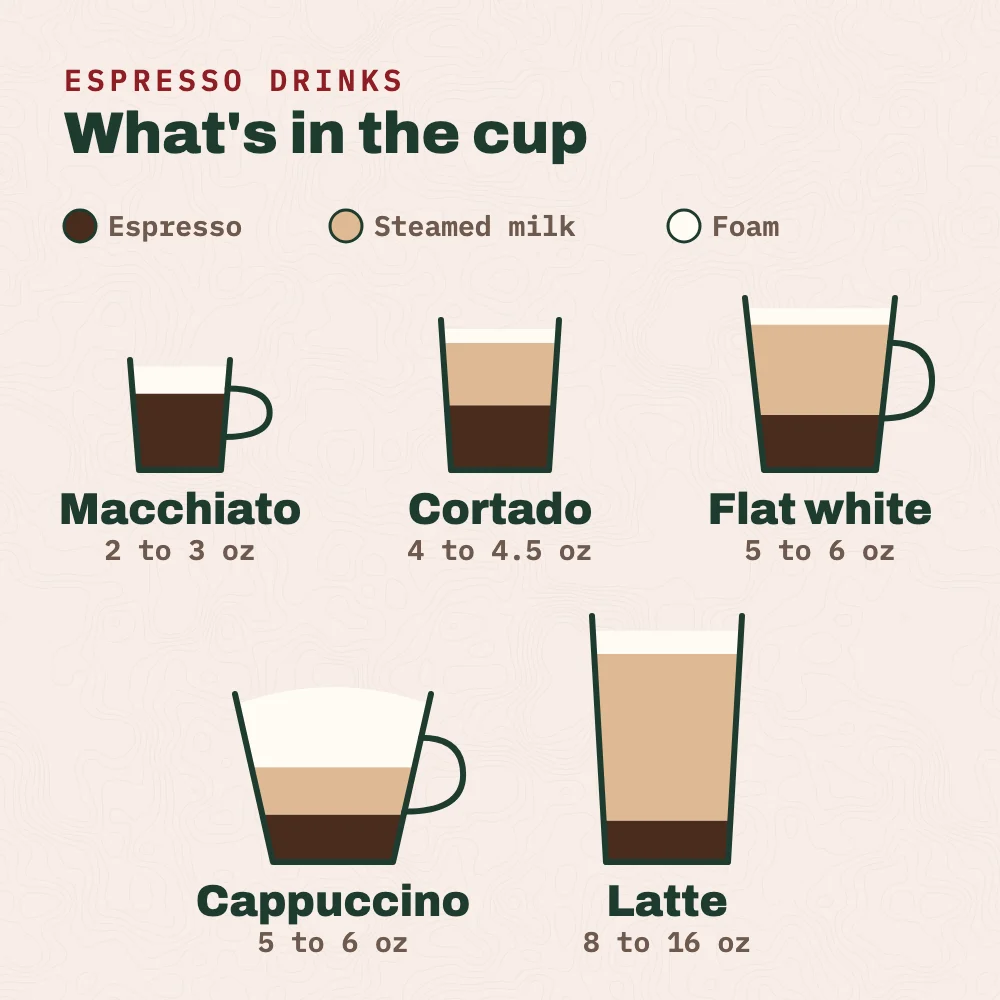
Cafés don’t all make these drinks the same way, so treat these as typical sizes rather than rules.
| Drink | Espresso | Milk and foam | Size |
|---|---|---|---|
| Macchiato | 1 or 2 shots | A spoonful of foam | 2 to 3 oz |
| Cortado | 2 shots | Same amount of warm milk, little foam | 4 to 4.5 oz |
| Flat white | 2 shots | Silky milk, thin foam | 5 to 6 oz |
| Cappuccino | 1 or 2 shots | Milk and a thick cap of foam | 5 to 6 oz |
| Latte | 1 or 2 shots | Lots of milk, thin foam | 8 to 16 oz |
Latte vs cappuccino
A latte and a cappuccino use the same two ingredients, espresso and steamed milk. The difference is the milk. A cappuccino is smaller, with a thick, airy layer of foam that traditionally fills about a third of the cup, so it tastes stronger and feels lighter. A latte has much more steamed milk and only a thin layer of foam on top, about half an inch (1 cm), so it’s creamier and milder.
In Italy, a classic cappuccino is small. The Italian Espresso National Institute describes one as about 25 ml of espresso topped with 100 to 125 ml of steamed, foamed milk, served in a cup of about 5 oz. Even where a café sells both in the same cup size, the cappuccino will have more foam and less milk.
You may also hear dry and wet. A dry cappuccino has extra foam and less milk. A wet one has more milk and less foam, which brings it closer to a latte. The name cappuccino is usually traced to the Capuchin friars, whose brown robes match the drink’s color. Latte is short for caffè latte, Italian for coffee with milk, so asking for just a latte in Italy may get you a glass of milk.
Flat white vs latte
A flat white is smaller than a latte and usually made with a double shot, so the coffee comes through more. The milk is steamed into fine, glossy microfoam and poured so only a thin, flat layer sits on top, which is where the name comes from. Most flat whites are 5 to 6 oz, while lattes start at about 8 oz. Both Australia and New Zealand claim the flat white, and both stories date to the 1980s.
A flat white and a cappuccino are about the same size. The cappuccino has a thick, airy cap of foam, and the flat white has a thin, silky one, so it tastes smoother and more of the coffee.
Cortado vs flat white
A cortado is a Spanish drink: espresso cut with about the same amount of warm milk. The name comes from cortar, Spanish for to cut. The milk is steamed with little or no foam, and the drink is about 4 oz, often served in a small glass. In US cafés that glass is often a 4.5 oz Gibraltar, and some cafés call the drink a Gibraltar.
A cortado is smaller than a flat white and about half milk, so it’s the stronger of the two. A flat white has about twice as much milk as espresso, plus a thin layer of microfoam. Next to a latte, a cortado is less than half the size and tastes far more of the coffee.
Macchiato vs latte
Macchiato means stained or marked in Italian, and three different drinks use the name.
- Espresso macchiato: the original. A single or double shot marked with a spoonful of milk foam, about 2 to 3 oz. It’s the strongest drink in this guide.
- Latte macchiato: the reverse. A tall glass of steamed milk marked with espresso poured on top, so it sits in layers. It’s even milkier than a latte.
- Caramel macchiato: the coffee-chain drink. At Starbucks it’s vanilla syrup and steamed milk with espresso poured over the top and a caramel drizzle, so it’s closer to a sweet vanilla latte than to a classic macchiato.
Order a macchiato in a specialty café and you’ll usually get the small, strong one. At a chain, you may get the sweet, milky one, so check the menu.
What is a breve?
A breve is an espresso drink made with steamed half-and-half instead of milk. Half-and-half is equal parts whole milk and cream, so a breve, often ordered as a breve latte, is richer and creamier than a latte, with thick, stable foam. It’s an American café drink, even though breve is Italian for short. Many cafés also treat breve as a request: ask for any drink breve and they’ll make it with half-and-half.
Two more names you’ll see on menus: a mocha is a latte with chocolate, and an americano is espresso topped up with hot water, with no milk at all.
Which has the most caffeine?
The caffeine comes from the espresso, not the milk. A 1 oz single shot has about 63 mg, so any drink with two shots has roughly 125 mg, whether it’s a 4 oz cortado or a 16 oz latte. What changes is how strong it tastes. From strongest to mildest, the order is usually macchiato, cortado, flat white, cappuccino, then latte. Cafés vary in how many shots go into each size, so ask if you want to know. For less caffeine, ask for a half-caff or decaf drink.
How to make them at home
You need espresso and a way to steam milk. An espresso machine with a steam wand does both, and our guide to the best beginner espresso machines compares good ones.
- Pull a double shot. A common starting recipe is 18 g of coffee in and 36 g of espresso out in about 25 to 30 seconds.
- Steam cold milk until the jug is hot to the touch, about 140 to 150°F (60 to 65°C). For a latte, flat white or cortado, let air in for just the first few seconds, then sink the wand so the milk swirls smooth. For a cappuccino, let air in for longer to build more foam.
- Pour the milk into the espresso. Stop at about the same amount of milk as espresso for a cortado, add about 4 oz for a flat white, or fill a bigger cup for a latte. For a cappuccino, spoon the thick foam on top.
No espresso machine? A moka pot or an AeroPress makes strong, concentrated coffee that works well with milk, though it isn’t true espresso. You can froth warm milk by pumping it in a French press. For milk drinks, medium-dark coffees with chocolate or caramel notes cut through the milk best, as our guide to espresso beans vs coffee beans explains.
Where this guide comes from
Most of these drinks have no single official recipe, and cafés make them differently. We drew on traditional definitions, such as the Italian Espresso National Institute’s cappuccino, plus common US café sizes and barista guides, and gave ranges where they disagree. The caffeine figure is the value for a 1 oz shot of espresso in Mayo Clinic’s caffeine chart, and the shot recipe matches our coffee ratio and grind size chart.
Espresso drinks FAQ
What is the difference between a latte and a cappuccino?
A cappuccino is smaller, with a thick layer of foam, so it tastes stronger. A latte has more steamed milk and only a thin layer of foam, so it’s creamier and milder.
Is a flat white stronger than a latte?
It tastes stronger, because it’s smaller and has less milk for the same double shot. If both have two shots, the caffeine is about the same.
Is a cortado the same as a flat white?
No. A cortado is about 4 oz, half espresso and half warm milk, with little foam. A flat white is 5 to 6 oz, with about twice as much milk as espresso and a thin layer of microfoam.
What is the difference between a macchiato and a latte?
A classic espresso macchiato is a shot with a spoonful of foam, about 2 to 3 oz, so it’s strong. A latte is mostly steamed milk. A chain-store caramel macchiato is different again: a sweet, milky drink closer to a vanilla latte.
What is a breve?
An espresso drink made with steamed half-and-half instead of milk, so it’s richer and creamier than a latte.
Which has more caffeine, a latte or a cappuccino?
Neither, if they have the same number of shots. The caffeine comes from the espresso, about 63 mg per single shot, not from the milk.
What is a dry cappuccino?
One with extra foam and less steamed milk. A wet cappuccino is the opposite, with more milk and less foam, which brings it closer to a latte.
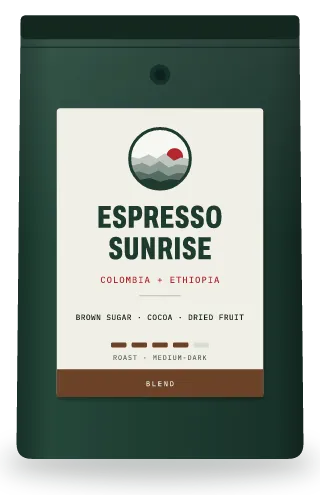
Make espresso drinks with Regions coffee
For lattes, cappuccinos and flat whites, Espresso Sunrise is our medium-dark espresso blend of Colombian and Ethiopian coffee. It pulls a syrupy shot with brown sugar and cocoa up front and a hint of dried fruit, and it cuts through milk. Our coffees are listed as coming soon, so tap Notify me on any coffee to hear when it’s ready.