
On this page
- Quick answer
- Rwanda and Burundi coffee at a glance
- What do Rwandan and Burundian coffees taste like?
- Why Rwanda and Burundi are sold side by side
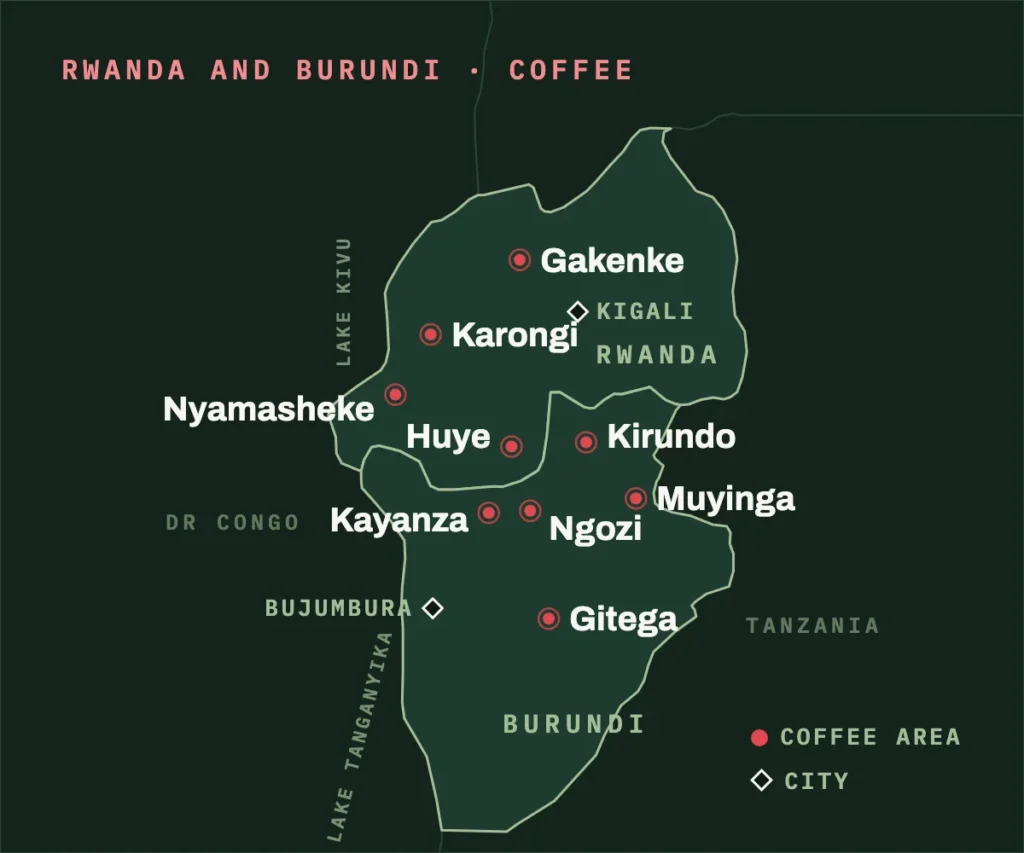
- Rwanda’s coffee regions
- How Rwanda turned to specialty coffee
- Burundi’s coffee regions
- How Burundi’s coffee is grown and sold
- What is the potato taste defect?
- How to brew Rwandan and Burundian coffee
- Where this guide comes from
- Rwanda and Burundi coffee FAQ
- The closest Regions coffee
Quick answer
Rwanda and Burundi are small, high neighbors in East Africa that grow mostly Arabica, largely Bourbon, on hundreds of thousands of family plots. Farmers sell their cherries to washing stations, which wash and dry the beans on raised beds. The best lots are sweet and bright, with citrus, red fruit, stone fruit and florals over a syrupy body. Both countries also carry the potato taste defect, a rare bean that smells of raw potato. It’s harmless: if a dose of grounds smells of potato, toss it and grind a fresh one.
Rwanda and Burundi coffee at a glance
| Rwanda | Burundi | |
|---|---|---|
| Coffee arrived | Early 1900s, under German rule | 1920s to 1930s, under Belgian rule |
| Grown at | About 1,200 to 2,200 m | About 1,400 to 2,000 m |
| Main areas | Lake Kivu, Huye and Nyamagabe, the north | Kayanza, Ngozi, Kirundo, Muyinga, Gitega |
| Who grows it | About 400,000 smallholder families | Hundreds of thousands of smallholder families |
| Recent crop | About 21,000 tonnes (2024/25) | About 6,000 to 26,000 tonnes, swinging year to year |
| Processing | About 80% fully washed | Mostly washed, often fermented twice |
| Harvest | Late February to June, later in the north | March to July |
What do Rwandan and Burundian coffees taste like?
Coffee Review describes the best Rwandas as almost always sweet and balanced, with a syrupy or satiny body, lively acidity and notes of honey-like flowers, stone fruit, citrus, red or black currant and cocoa. Weaker lots can taste flat or woody. Burundi’s top coffees tend toward sweet-tart, with citrus brightness, stone fruit and berries, chocolate and florals.
The two are close enough that importers often describe them in the same words. Coffee Review’s notes suggest Burundi’s best lots lean a little more tart and Rwanda’s a little more balanced, but the washing station, the processing and the roast matter more than the border. Lighter roasts show the fruit and flowers best. Our guide to tasting notes explains what words like “bright” and “sweet-tart” mean in the cup.
Why Rwanda and Burundi are sold side by side
They share a border, a landscape of steep green hills, and a history. Belgium governed them together as Ruanda-Urundi until both became independent in 1962, and colonial rules made coffee growing compulsory in both. The same Bourbon trees spread through each country, and today both rely on smallholders who pick ripe cherries and carry them to a nearby washing station. Importers buy from both in the same season and often report on them together.
Bourbon is an old Arabica variety known for sweetness, and our guide to coffee bean types puts it next to the others. Bourbon types make up roughly 95 percent of Rwanda’s trees, by one large importer’s estimate, including selections called BM139 and Jackson. Every lot on the winners’ list of Burundi’s 2018 Cup of Excellence was Bourbon.
Rwanda’s coffee regions
Coffee grows in all of Rwanda’s provinces, at about 1,200 to 2,200 m. Rwanda’s export board puts most of it below 1,900 m, while importers list some farms at the edge of Nyungwe forest at 2,200 m or more. Bags usually name the district, and sometimes the washing station.
Lake Kivu: Karongi, Rutsiro, Nyamasheke and Rusizi
The hills above Lake Kivu, in the Western Province, are Rwanda’s best-known coffee country. The lake sits at about 1,460 m, and washing stations in Nyamasheke run from about 1,500 to 1,850 m. Rwanda’s coffee story starts here too: the first trees are usually said to have been planted at Mibirizi, in Rusizi District at the lake’s southern end, around 1904. The harvest begins here first, in late February.
The south: Huye and Nyamagabe
Huye, the old university town once called Butare, is where Rwanda’s specialty coffee took off. One of the country’s first washing stations opened at Maraba, nearby, in the early 2000s. Nyamagabe, to the west, climbs toward Nyungwe forest, where some of Rwanda’s highest coffee grows.
The north and east
In the Northern Province, coffee grows in Musanze, at the foot of the Virunga volcanoes, and in Gakenke, just to the southeast. Some northern farms keep picking into August. The Eastern Province, in districts like Kayonza, Ngoma and Kirehe, is lower and warmer, at about 1,200 to 1,700 m.
How Rwanda turned to specialty coffee
German colonists brought coffee to Rwanda in the early 1900s, and in the 1930s Belgian rule made growing it compulsory. By 1970, coffee brought in about 70 percent of the country’s export revenue. For most of the century, though, it sold as low-priced commodity coffee.
That changed after 2000. A USAID-funded program called PEARL, run by Michigan State University with Texas A&M from 2000 to 2006, helped farmer cooperatives build washing stations and learn to judge quality, and a follow-up called SPREAD began in 2006. In 2008, Rwanda became the first African country to hold a Cup of Excellence, the competition and auction for a country’s best lots. It now also runs its own national competition, Best of Rwanda.
- Farmers: about 400,000 smallholder families, by Rwanda’s National Agricultural Export Development Board (NAEB).
- Washing stations: about 300. NAEB’s counts have ranged from 245 in 2015 to 309 in 2020.
- Crop: about 21,000 tonnes in the 2024/25 season, and 23,860 tonnes exported in calendar 2025, worth a record $149 million or so, by NAEB’s figures.
- Processing: about 80 percent fully washed. Naturals, honeys and anaerobic lots make up about 5 percent of exports.
- Selling: in 2023 Rwanda dropped its zoning rule, so farmers can now sell cherries to any washing station rather than an assigned one.
Burundi’s coffee regions
Much of Burundi’s specialty coffee comes from the north, along the Rwandan border. In 2025 Burundi merged its 18 provinces into five, so Kayanza and Ngozi are now part of a new province called Butanyerera, and Muyinga is part of Buhumuza. Many importers still use the old names, and some now print both. The altitudes below come from importers’ notes.
| Area | Grown at | Worth knowing |
|---|---|---|
| Kayanza | About 1,700 to 2,000 m | Among Burundi’s highest, on the Rwandan border |
| Ngozi | About 1,600 to 1,900 m | Home of the first natural to win Burundi’s Cup of Excellence, in 2019 |
| Kirundo | About 1,400 to 1,700 m | Lower, in the far north |
| Muyinga | About 1,800 m | The northeast, near Tanzania |
| Gitega | About 1,500 to 1,800 m | The central plateau, around Burundi’s capital since 2019 |
How Burundi’s coffee is grown and sold
Coffee arrived in Burundi under Belgian rule in the 1920s or 1930s, depending on the source, when farmers were required to plant it. It has been one of the country’s main exports ever since: about a fifth of export earnings on average from 2020 to 2024, by French Treasury figures, just behind gold.
- Farmers: hundreds of thousands of smallholder families. The World Bank counts more than 600,000 households, and other estimates run from 200,000 to 800,000.
- A crop that swings: about 25,800 tonnes of green coffee in 2018/19, about 6,300 tonnes in 2021/22, and about 12,000 tonnes forecast for 2025/26.
- Washing stations: a few hundred. Counts run from about 220 to 354, depending on the year and who’s counting.
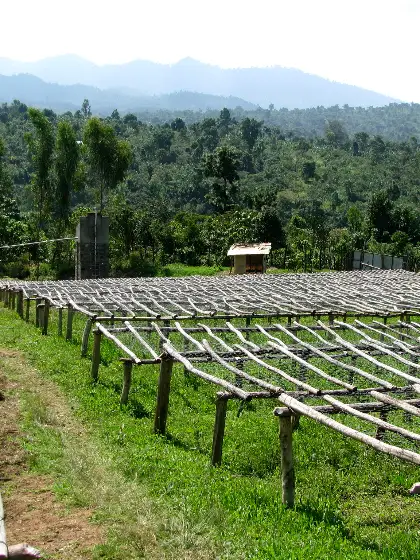
- Double fermentation: many stations ferment the beans twice, typically 12 to 18 hours dry, then again under water, sometimes followed by a soak. The beans then dry on raised beds for two to three weeks. Our processing guide explains how washing works.
- Who runs it: most washing stations were run by state companies until the government began selling some to private buyers in 2009. In 2020, Burundi created a national coffee office, ODECA, and brought much of the chain back under state control. Private and cooperative stations still operate, and exporters need ODECA’s approval.
- Cup of Excellence: first held in Burundi in 2012, and most recently in 2019, the last year its organizer lists. That year a natural-process coffee from Gatukuza, in Ngozi, won for the first time.
What is the potato taste defect?
Now and then, a coffee from this part of Africa has one bean that smells and tastes of freshly peeled raw potato. It’s called the potato taste defect. It turns up mainly in Rwanda, Burundi, the Democratic Republic of the Congo and Uganda, and less often in Tanzania and Kenya. A single bean is enough to flavor a whole pot, and an affected bean looks like any other.
The cause isn’t fully settled. World Coffee Research ties it to damage from the Antestia bug, which feeds on coffee cherries. Bacteria that get into the damaged beans are thought to produce the potato-smelling compound, a pyrazine called IPMP. Other researchers say the link isn’t proven yet. Producers fight it by stripping the last fruit from the trees after harvest, pruning, careful spraying, floating the cherries, and sorting the beans by hand or under UV light. Counter Culture’s data, reported by the importer Sucafina in 2019, put it at roughly one bad bean per 1,150 g of coffee, a little over 2½ pounds.
It isn’t harmful. World Coffee Research says plainly that there are no health risks. It just tastes bad. Here’s what to do at home:
- Grind one dose at a time and smell the grounds before you brew.
- If they smell of raw potato, compost that dose. The smell carries straight into the cup.
- Run a few beans of another coffee through the grinder to clear it, then grind a fresh dose. The rest of the bag is usually fine.
How to brew Rwandan and Burundian coffee
Most of these coffees are washed and sold at light to medium roasts, so brew them in a way that keeps the fruit. Our original AeroPress is a good fit. We use it upside down, the inverted method: 15 g of coffee to 180 g of water (1:12), ground fine to medium-fine, steeped 1 to 2 minutes, then pressed slowly. It makes a small, strong cup. Add a splash of hot water afterward if you like it lighter.
For pour-over, start at about 1:16, for example 22 g of coffee to 350 g of water, ground medium-fine, with water just off the boil, about 200 to 205°F. If it tastes sour, grind a little finer. If it tastes bitter or dry, grind a little coarser. Our pour-over ratio guide walks through the bloom and the pours step by step.
Where this guide comes from
We haven’t visited either country. The Rwandan figures come from NAEB, as reported in Rwandan and African business press, and the Burundian ones from the World Bank, the French Treasury and Burundian news reports. The potato taste defect section draws on World Coffee Research’s 2023 white paper and Counter Culture’s notes. The rest comes from the Alliance for Coffee Excellence, Coffee Review, World Coffee Research’s variety catalog and importers’ origin notes from Cafe Imports, Sucafina, Royal Coffee and Two Lakes, all read in November 2026. Burundi’s numbers vary most between sources, so we’ve given ranges.
Rwanda and Burundi coffee FAQ
Is Rwandan coffee good?
The best of it is very good. Since the early 2000s, Rwanda has built hundreds of washing stations and was the first African country to hold a Cup of Excellence, in 2008. Good lots are sweet and balanced, with citrus, stone fruit and floral notes.
What does Burundi coffee taste like?
Sweet and bright, often a little tart, with citrus, stone fruit, berries, chocolate and flowers. It’s similar to Rwandan coffee, since both grow mostly Bourbon at similar altitudes.
Is Rwandan coffee Arabica or Robusta?
Almost all Arabica, mostly Bourbon types. Burundi’s specialty coffee is Arabica too.
What’s the difference between Rwanda and Burundi coffee?
Less than you might think. They grow the same Bourbon types the same way, on small farms that sell to washing stations. Burundi’s best lots often lean a little more tart and Rwanda’s a little more balanced, but the farm, processing and roast matter more.
Why does my coffee taste like potato?
It probably has the potato taste defect, a rare bean linked to insect damage that smells of raw potato. It’s most common in coffee from Rwanda and Burundi. It isn’t harmful. Throw out that dose of grounds and grind a fresh one.
Is Rwandan coffee acidic?
It tastes bright, with lively, fruity acidity, especially at a light roast. If you prefer a mellower cup, our low-acid coffee guide covers the beans and roasts that taste softer.
When are Rwanda and Burundi coffees harvested?
Roughly March to July in both, starting in late February around Lake Kivu and running into August in parts of northern Rwanda.
The closest Regions coffee
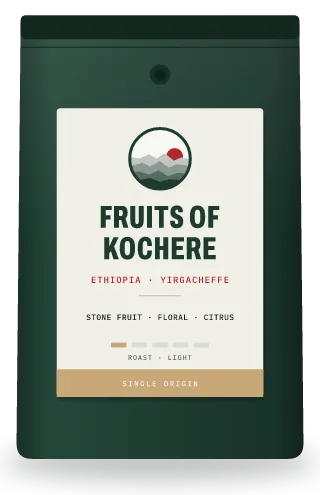
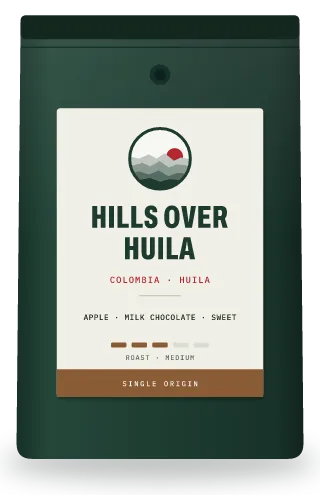
Neither country is in our lineup yet. For the same bright, floral side, try Fruits of Kochere, a light roast from the Kochere area of Yirgacheffe, Ethiopia, with a floral aroma, juicy stone fruit and a citrus finish. Its page calls it almost tea-like. For something rounder, Hills Over Huila, a medium roast from Huila, Colombia, has crisp apple, milk chocolate and a sweet, clean finish, and its page gives an AeroPress recipe of 15 g of coffee to 220 g of water, medium-fine, for about 1½ minutes. Both are still coming soon, with a Notify me button on each page.